Visit our team and see our AIRCRAFT.
ERC is present at industry events across Europe. Meet the team, see the aircraft, and speak with our engineers and commercial leads directly.
Read about our latest News and Achievements.
From flight milestones to industry partnerships. Follow ERC's progress as we build Europe's new standard for critical airlift.
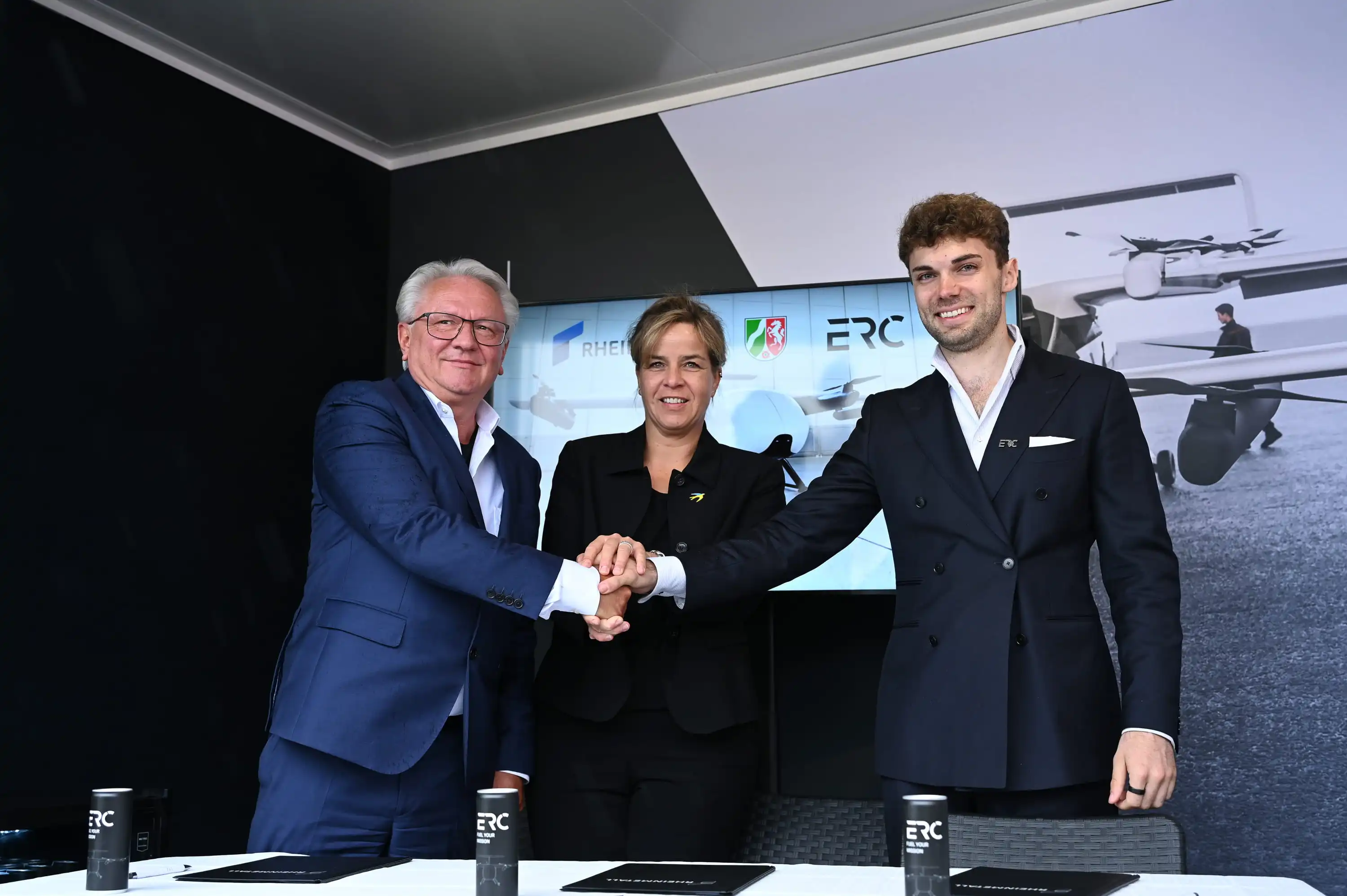
Rheinmetall, ERC System and the State of North Rhine-Westphalia have signed a Memorandum of Understanding to establish production of the hybrid-electric heavy-lift cargo drone Victor U250 in NRW. The partnership aims to build local production and supply chains and create a three-digit number of jobs by 2029.
Rheinmetall, ERC System and the State of North Rhine-Westphalia sign a Memorandum of Understanding on the potential establishment of heavy-lift cargo drone production in NRW
Key facts
- Strategic collaboration on the potential establishment of the hybrid-electric heavy-lift cargo drone Victor U250 in North Rhine-Westphalia
- Build-up of a production site and relevant supply chains in NRW planned
- Market launch and industrialisation of the Victor U250 to be advanced
- In the medium term, a three-digit number of jobs is to be created
Berlin, 10 June 2026 – At ILA Berlin 2026, Rheinmetall, ERC System and the State of North Rhine-Westphalia have entered into a strategic partnership. The aim is to lay the groundwork for the production of the heavy-lift cargo drone Victor U250 in North Rhine-Westphalia
The partners plan to jointly advance the market launch of the Victor U250 by building up local production and supply chains. If successfully implemented, relevant high technologies will be secured in North Rhine-Westphalia and Germany over the long term. In this context, a three-digit number of jobs is to be created by 2029.
The uncrewed, hybrid-electric heavy-lift cargo drone Victor U250 is distinguished in particular by a payload of up to 250 kilograms over 300 kilometres, infrastructure-independent vertical take-off combined with fast cruise flight at around 250 km/h, and a modular payload system.
Rheinmetall contributes its capabilities as an approved aviation organisation and as a provider of solutions for uncrewed flight systems. ERC develops so-called vertical take-off and landing aircraft (eVTOLs) in Germany, currently with a predominantly hybrid-electric propulsion system, for critical missions. They are used, among other areas, in military logistics as well as offshore and coastal logistics, disaster response and medical passenger transport.
The State of North Rhine-Westphalia supports the partners in assessing suitable funding options and site options. It also intends to provide coordinated support for the relevant permitting and approval procedures.
Armin Papperger, CEO of Rheinmetall:
“With today’s Memorandum of Understanding, we are laying the foundation for the industrialisation of a forward-looking uncrewed flight system in Germany. Ultimately, together with ERC and the State of North Rhine-Westphalia, we want to scale the heavy-lift cargo drone Victor U250 both technologically and industrially.”
Mona Neubaur, Deputy Minister-President of the State of NRW:
“ILA 2026 shows how North Rhine-Westphalia is shaping the future: with strong research, innovative companies and close European partnerships. We take our responsibility for Europe’s sovereignty seriously and make a decisive contribution to the resilience of our state – in NRW, in Europe and in space.”
Maximilian Oligschläger, Chief Commercial Officer, ERC:
“The Victor U250 addresses central requirements of current and future logistics and transport tasks for critical missions in defence, disaster response and commercial logistics. The planned collaboration offers the opportunity to bring development, market launch and industrial implementation together consistently in Germany.”
Prof. Dr.-Ing. Rudolf F. Schwarz, Chairman of the Management Board and Owner, IABG:
“The collaboration combines technological innovation with industrial implementation expertise in order to expand strategic key technologies and strengthen Germany’s sovereignty.”
About Rheinmetall AG
Rheinmetall AG is an integrated technology group headquartered in Düsseldorf. Founded in 1889, the company is a leading international systems house in the defence industry, active in the land, air, sea and space domains. Sustainability is an integral part of Rheinmetall’s strategy. With around 33,000 employees at some 180 sites worldwide, Rheinmetall has been listed in the DAX 40 since March 2023 and generated sales of EUR 9.9 billion in fiscal year 2025.
About ERC System GmbH
ERC System is a German technology company based in Ottobrunn near Munich and a wholly owned subsidiary of Industrieanlagen-Betriebsgesellschaft mbH. ERC develops eVTOLs – electrically powered aircraft capable of vertical take-off and landing – currently with a predominantly hybrid-electric propulsion system. Its focus is on uncrewed and crewed product variants for various critical mission areas, in particular defence logistics as well as medical & passenger transport.
About Industrieanlagen-Betriebsgesellschaft mbH (IABG)
The owner-managed Industrieanlagen-Betriebsgesellschaft mbH, headquartered in Ottobrunn near Munich, is one of Europe’s leading independent technology companies. It supports public-sector clients and industrial companies with analysis, simulation, testing and validation services for complex systems and technologies. With scientific expertise, systems understanding and highly specialised test infrastructure, IABG assesses safety, performance and reliability under real operating conditions.
Contacts
Rheinmetall
Oliver Hoffmann – Head of Public Relations
Phone: +49 211 473-4748
ERC System
Benedikt Albertsen
Phone: +49 89 608882 66
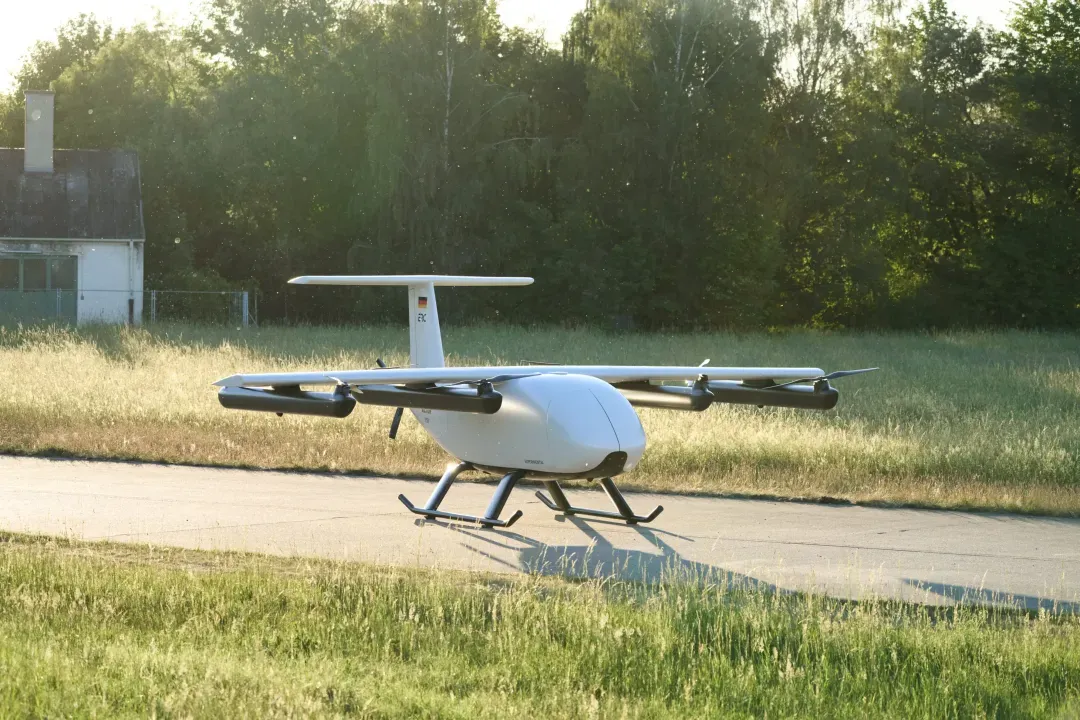
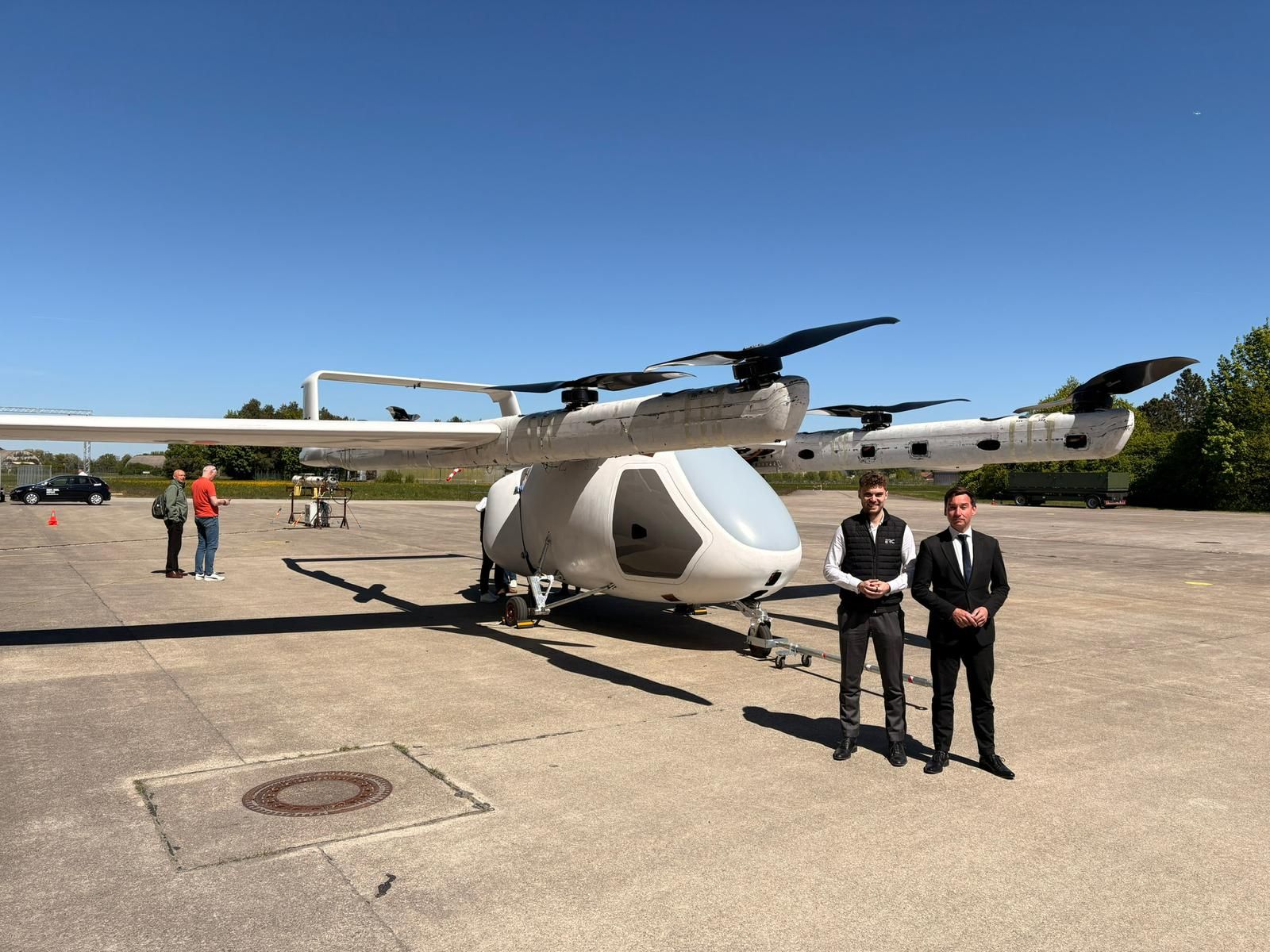
ERC System has launched Victor, an uncrewed hybrid-electric heavy-lift cargo drone designed for military resupply and critical dual-use logistics. Unveiled at ILA Berlin 2026, it's built to carry 250 kg over 300 km, with first deliveries targeted for 2028.
ERC System Launches Heavy-Lift Cargo Drone “Victor” for Military Resupply and Critical Logistics Missions, Targeting First Deliveries in 2028
June 10th, 2026
• ERC System launches “Victor”, an uncrewed hybrid-electric cargo drone (UAS) for military resupply and critical logistics missions, with the public unveiling of a full-size Victor U250 at ILA 2026 Berlin
• Designed for the target mission of transporting 250 kg of payload over 300 km at a cruise speed of 250 km/h, Victor addresses a capability gap in defense logistics recognized widely across Europe
• The new aircraft combines vertical take-off and landing, high cruise speed, a modular payload handling system, and optimized field deployment capability
• ERC targets first deliveries of series aircraft to military and civil customers in 2028, capitalizing directly on the startup’s prior learnings from flying “Romeo”, the EU’s heaviest flying uncrewed eVTOL to date
BERLIN / MUNICH, GERMANY – ERC System today announced the launch of “Victor”, a dual-use heavy-lift cargo UAS designed for critical missions in fields such as defense, commercial logistics, and disaster response. Presented publicly at ILA Berlin 2026, Victor aims to close a military capability gap through a scalable, deployable solution for infrastructure-independent, uncrewed aerial logistics above 200 kg of payload.
Victor is designed to transport up to 250 kilograms of payload over a distance of 300 kilometers, at a cruise speed of 250 km/h. Its lift-and-cruise architecture – taking off vertically, but using wings for fast forward flight – enables access to sites with limited infrastructure while providing higher speed, longer range, and faster cargo throughput than pure multicopter designs.
“Over the past 18 months, we were repeatedly approached by military and civilian operators and asked to apply our experience from building ‘Romeo’, the EU’s heaviest uncrewed eVTOL (electric Vertical Take-Off and Landing), towards a heavy-lift cargo drone”, said Maximilian Oligschläger, ERC’s Chief Commercial Officer. “We have applied our technical learnings from the ongoing, crewed ‘Charlie’ program and combined them with deep operator insights. The results were quite clear: High payload, long range, fast cruise, and operational flexibility matter most. ‘Victor’ combines these in one platform with a level of versatility that will enable numerous critical mission profiles.”
Military decision-makers from across the continent are currently facing the same challenge: There is no market-available uncrewed platform that can move meaningful payloads over distances and at the speed needed to adequately support forward military units. When ground transport is blocked, and crewed air transport is too risky, there is currently no option. Victor changes that with its ability to move up to two pallets and deliver payload via cargo-drop, eliminating the need to land in undesirable environments.
ERC has set 2028 as the target for first deliveries, a challenging goal only few European companies would be able to achieve. “We are confident about our timeline, given our 6-year experience building some of the heaviest electrified aircraft in the EU,” Oligschläger explained. “Combined with strategic partnerships particularly focused on industrialization, we believe we have the capabilities to help close the gap quickly.”
Beyond defense logistics, ERC sees initial demand for Victor in offshore and coastal logistics, critical infrastructure supply and maintenance, remote industrial operations, and civilian disaster response. The company is working with selected partners in these segments, including some from the existing ‘Charlie’ program, to refine the product and prepare for rapid entry into service.
About Victor
Technical designator: Victor U250
Aircraft type: Uncrewed hybrid-electric heavy-lift cargo UAS
Primary mission focus: Military resupply and critical dual-use logistics
Target design mission: 250 kg payload over 300 km
Target cruise speed: 135 knots / approx. 250 km/h
Aircraft architecture: Lift-and-cruise eVTOL
Wingspan: Approx. 8 m
Payload concept: Modular payload system
Payload handling: Front load and payload drop
Pallet capability: Two ISO-standard palletized payload positions
Powertrain: Hybrid-electric, fuel-based operation
Field deployment: Transportable in a standard 20-foot ISO container
About ERC System
ERC System is a Munich-based aviation startup that develops electrified aviation solutions for the most critical missions. The company’s hybrid-electric aircraft take off vertically like helicopters, but fly forward wing-borne, like airplanes. They provide high speeds, long ranges, and cost-efficient operations for cargo, patient, and passenger transport as well as uncrewed utility applications.
Founded in 2020 by experienced aerospace professionals, ERC currently has approximately 60 employees and is backed by aerospace powerhouse IABG, a leading provider of testing and certification services for aircraft, spacecraft, and defense solutions. The ERC team focuses on heads-down engineering, capital- efficient development, and designing aircraft that fulfill highest customer and regulatory requirements.
ERC’s product portfolio comprises Victor, an uncrewed, hybrid-electric lift-and-cruise eVTOL (UAS) for logistical use cases, and Charlie, a crewed hybrid-electric lift-and-cruise eVTOL optimized for patient and passenger transport.
Contact for press inquiries
Benedikt Albertsen
Email: press@erc-system.com
Mobile: +49 89 608882 66
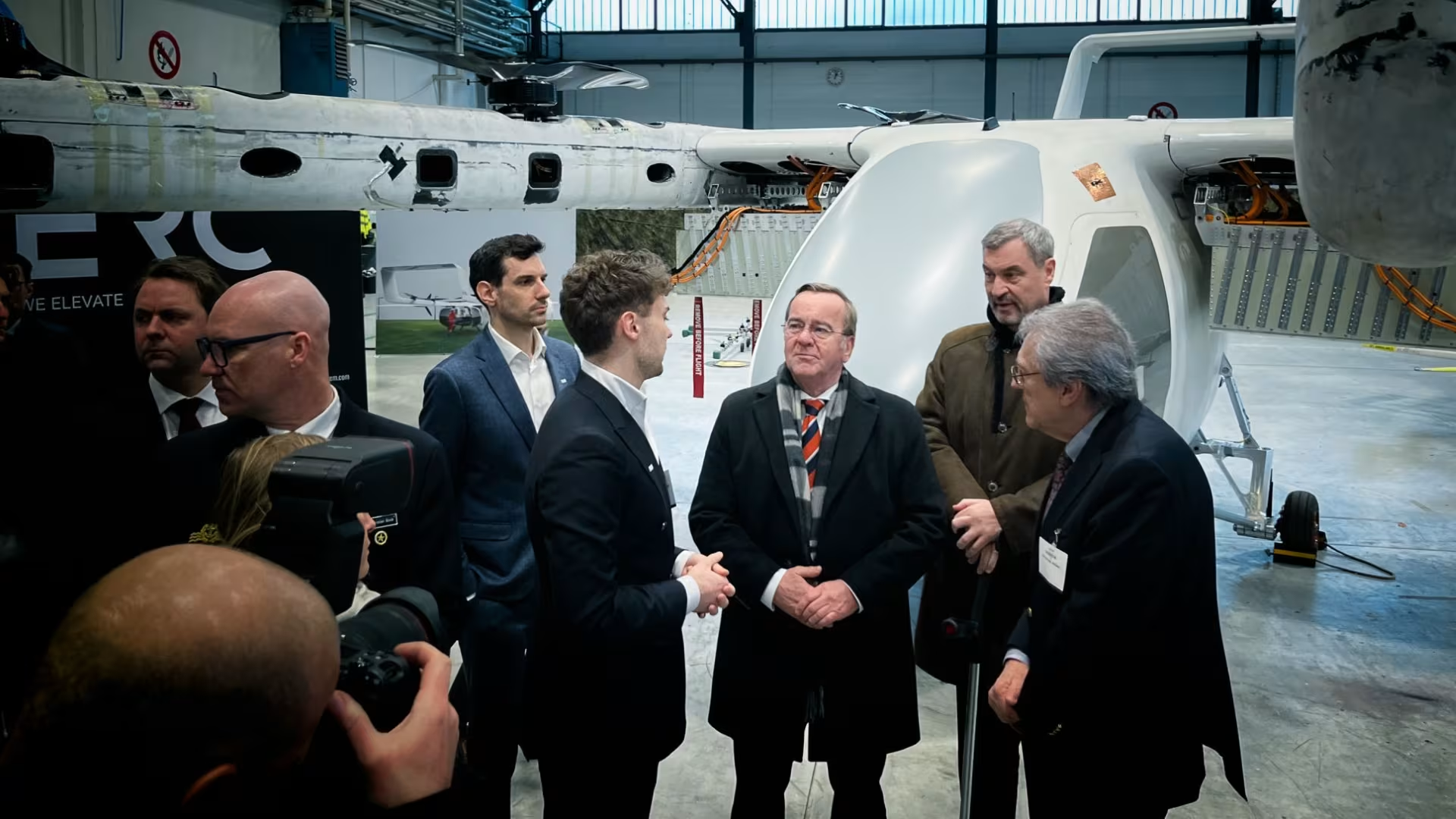
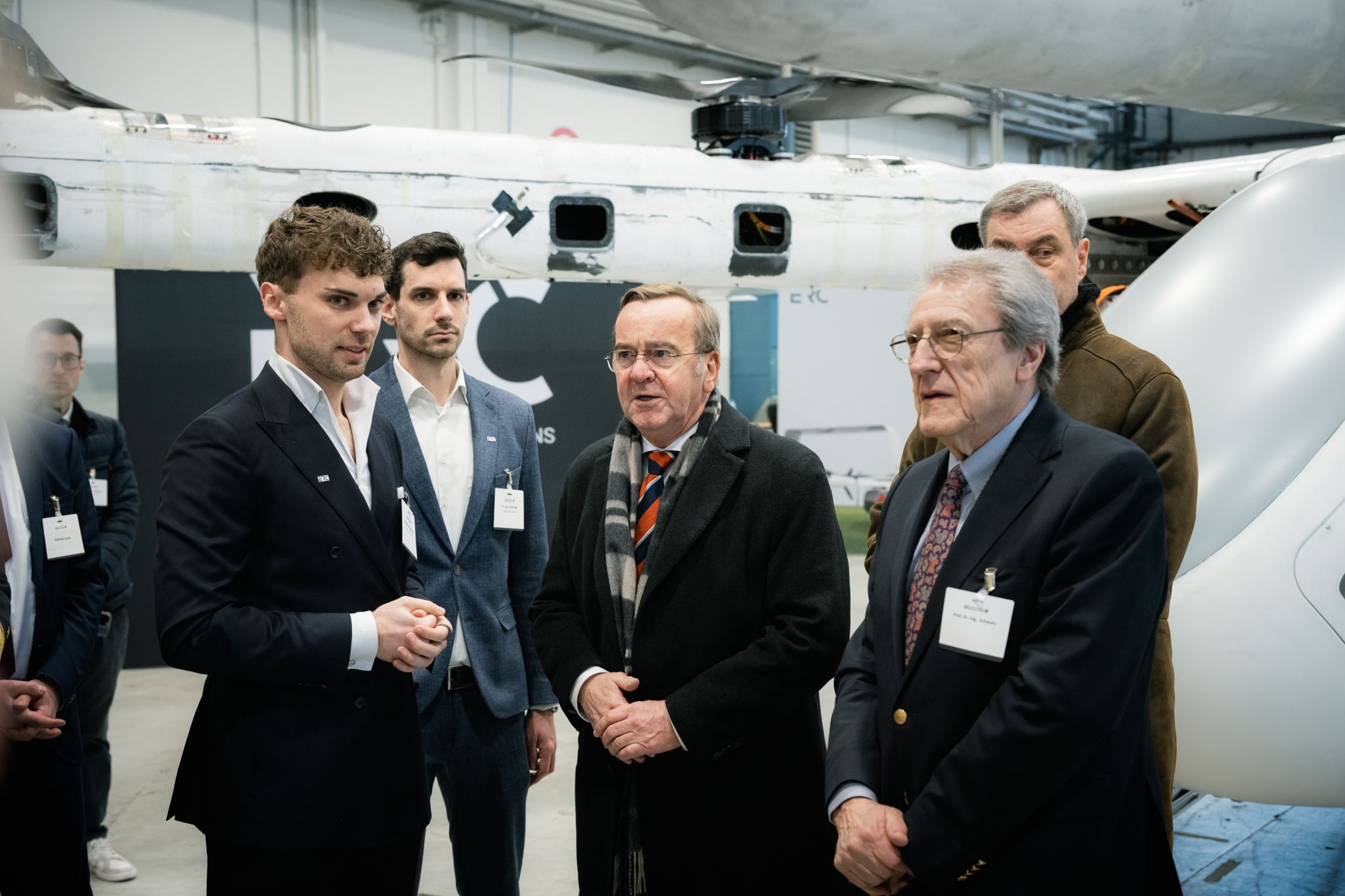
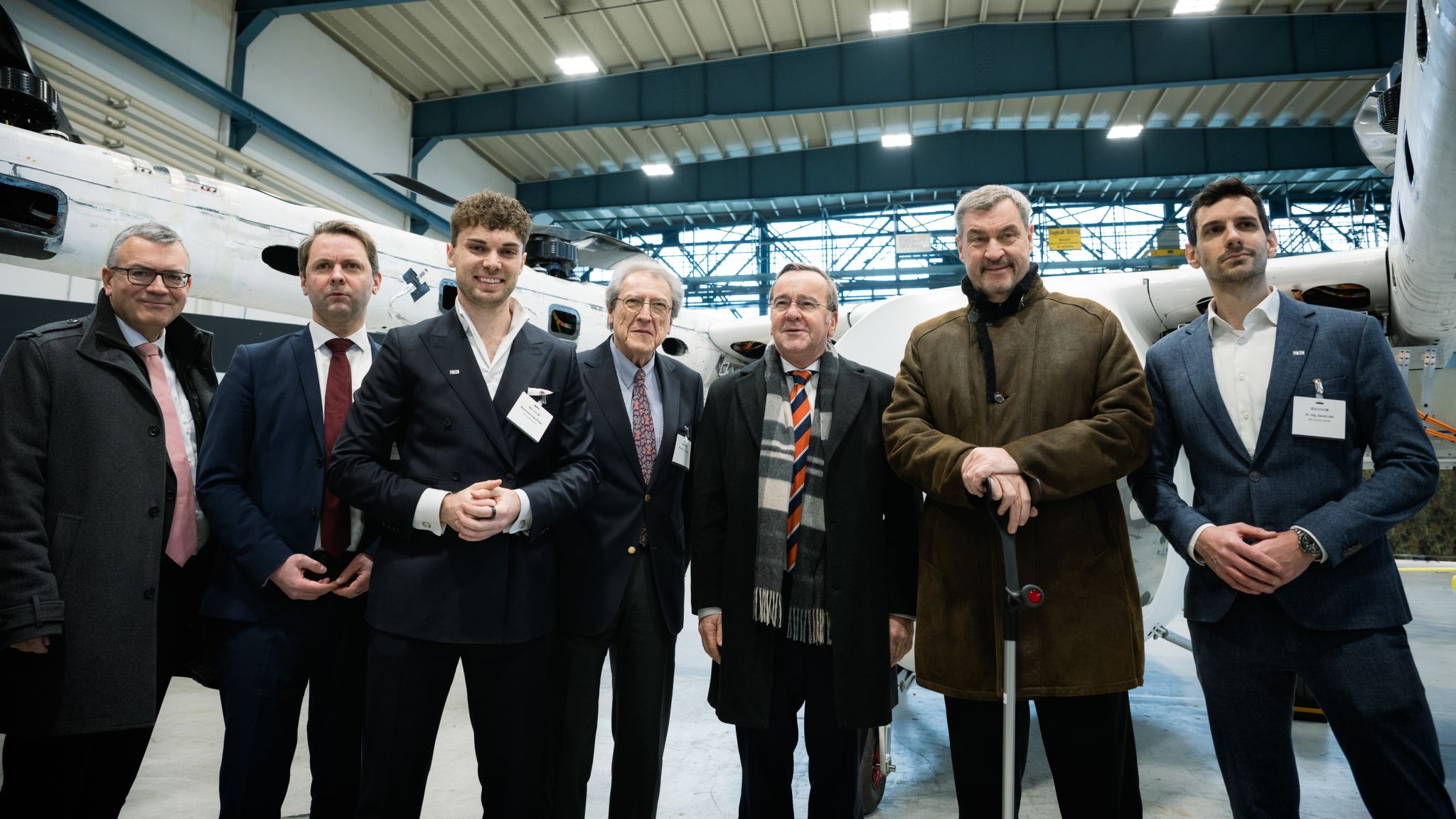
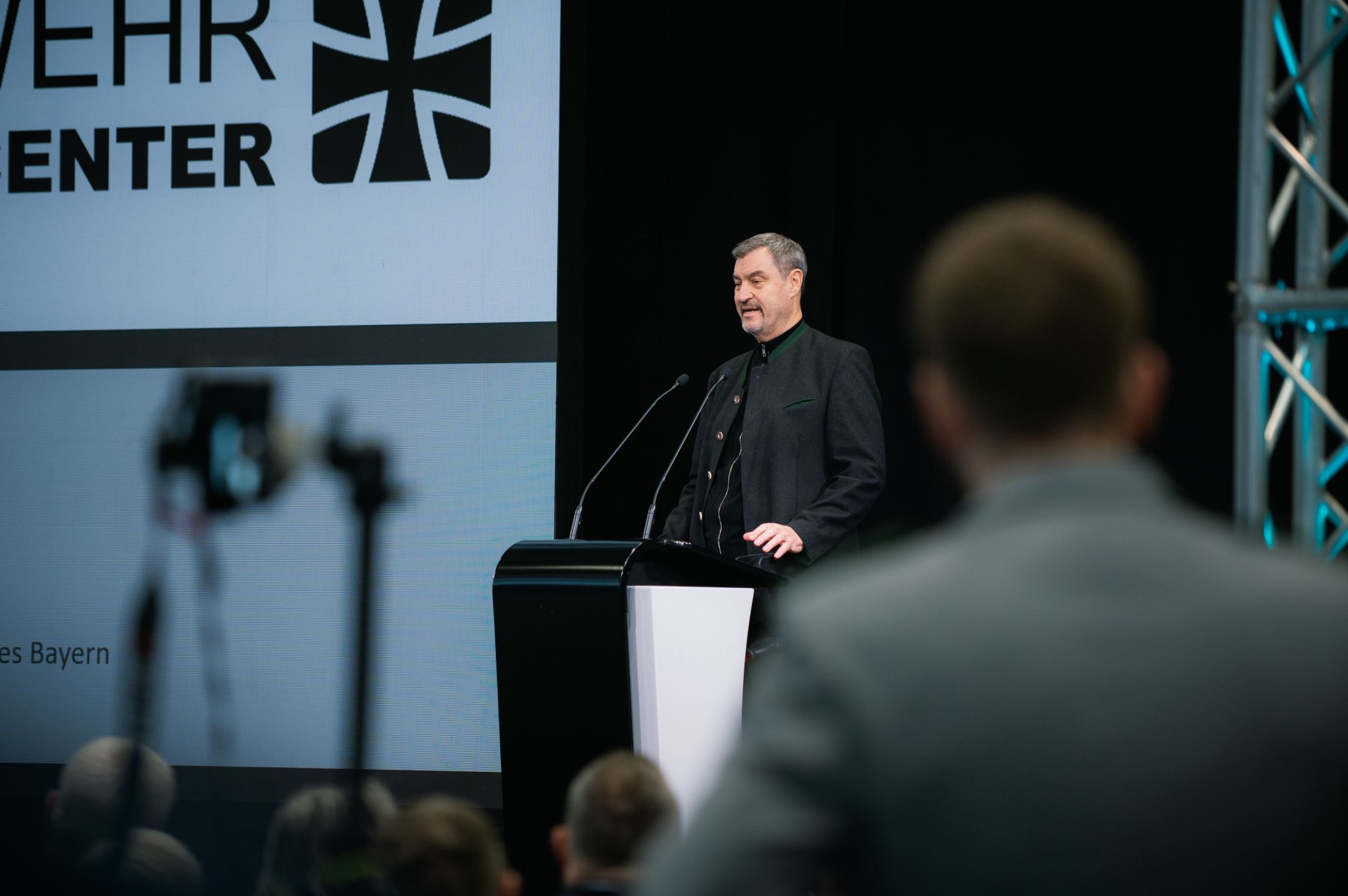
German Defence Minister Boris Pistorius and Bavarian Prime Minister Markus Söder visited ERC for the opening of the Bundeswehr Innovation Center. The conversation: what it takes to move defence aviation from prototype to industrial scale.
Today we had the honor of welcoming German Minister of Defence Boris Pistorius and Bavarian Prime Minister Dr. Markus Söder to ERC System.
After our presentation on how we want to elevate critical missions, we had a great discussion on the next steps needed to scale and industrialize these capabilities.
What we are most excited about: We are seeing a real shift toward practical innovation enablement - and that is essential in a highly regulated industry like aviation. Startup cooperations with the Bundeswehr make it possible to test our large unmanned prototypes quickly and pragmatically on military grounds - which accelerates learning and development.
Now, to reach industrial scale, we need the next level: Milestone-based funding, faster procurement pathways, and clear routes to adoption. That is where policy can unlock the biggest impact - and, as Markus Söder often says, help keep future industries in Bavaria and Germany.
Thank you to Christian Bock, Bayern Innovativ GmbH, and everyone involved for making this happen on such short notice.
PS: We are hiring. If you want to elevate critical missions with us - this is your moment.
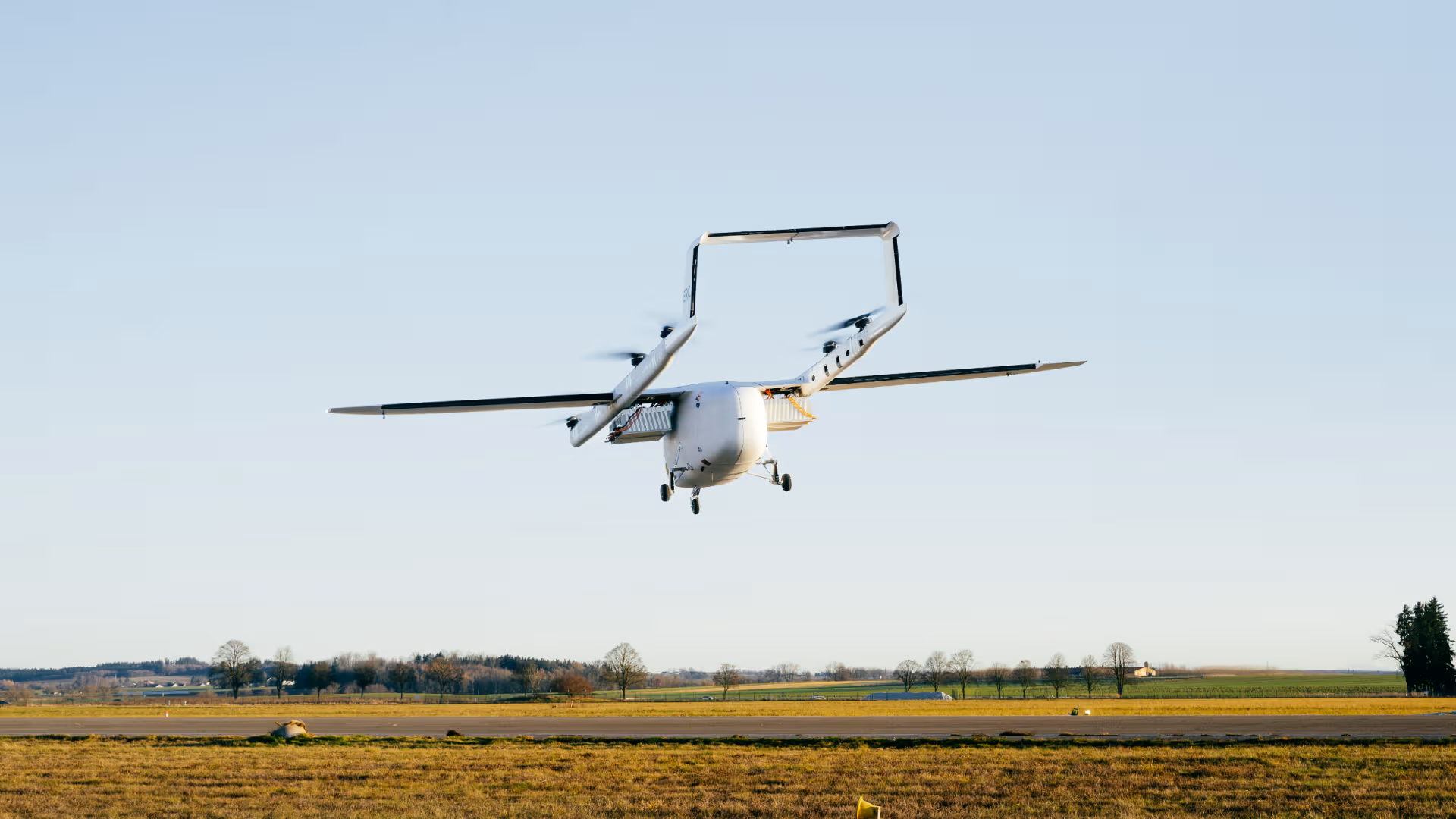
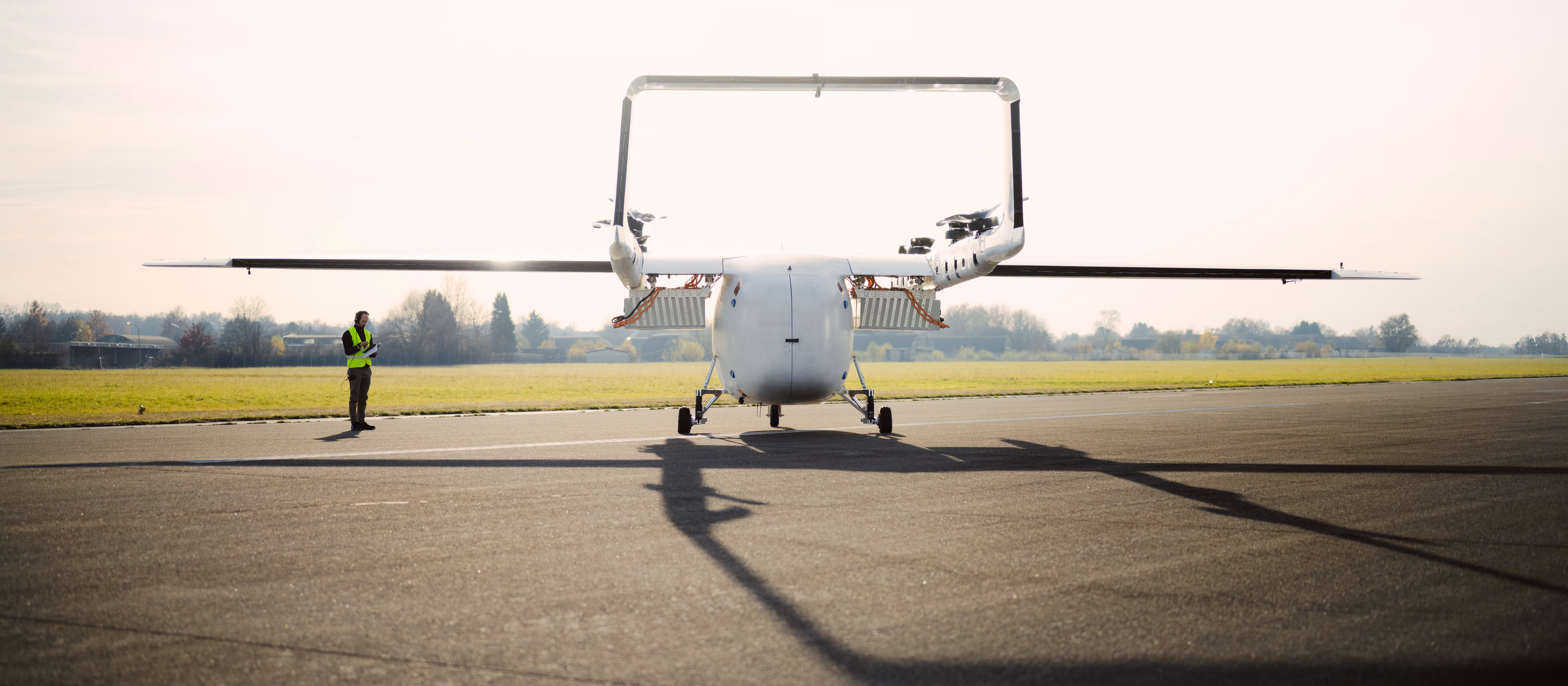
We have begun flight testing Romeo, our latest full-scale, full-mass prototype — and one of the largest eVTOLs flown in Europe to date. This is the milestone that separates demonstration platforms from production candidates.
We have begun flight testing "Romeo"
— our latest full-scale, full-mass prototype and one of the largest eVTOLs flown in Europe to date, at 2,735 kg and a 16-metre wingspan.
Achieving this milestone took months of dedicated teamwork and marks our transition from concept to practical testing – tackling the hardest part of eVTOL development early: proving the aircraft’s ability for safe, controlled vertical flight at full mass.
Romeo has executed numerous uncrewed test flights since November to inform the development of our first commercially available aircraft. The crewed, hybrid-electric future production aircraft is being designed as a versatile aerial transporter for critical missions. Leading HEMS operators, including strategic partner DRF Stiftung Luftrettung gemeinnützige AG, are involved to tailor the aircraft to patient transport needs.
ERC has built and flown Romeo with a small staff of only about 60 people. Addressing the team, CEO and Co-Founder David Loebl stated: “We are excited to have reached this key milestone in our mission to make aerial transportation more economically feasible, especially for critical missions.“ Near-term, ERC also intends to add an uncrewed cargo aircraft (UAS) to its portfolio to serve the commercial, governmental, and defense markets.

In a joint whitepaper with Roland Berger, we examine how AAM is repositioning away from urban air taxis toward mission-driven use cases — air ambulance, defense, and dual-use cargo — and what it means for the industry's path to market.
Over the past months, we have moved from concept to flight testing with "Romeo", our latest full-mass prototype.
For us, this milestone goes beyond flying a novel aircraft. It reflects how Advanced Air Mobility is transforming from ambition to deployment.
As we get closer to real-world deployment, it becomes clear that scalable business models must build on existing operational demand. These existing, time-critical use cases are most commonly found in public service and defense contexts, including medical evacuation and dual-use cargo missions.
Together with Roland Berger, we have recently examined how this structural shift is reshaping go-to-market strategies across Advanced Air Mobility: from passenger-first concepts towards mission-driven deployment models.
Our conclusion is clear: Mission-critical use cases will drive AAM deployment.
At ERC System, this perspective has guided our decisions from day one. Our platform strategy is built around medical, governmental, and defense operations. Which do you think will deploy first?
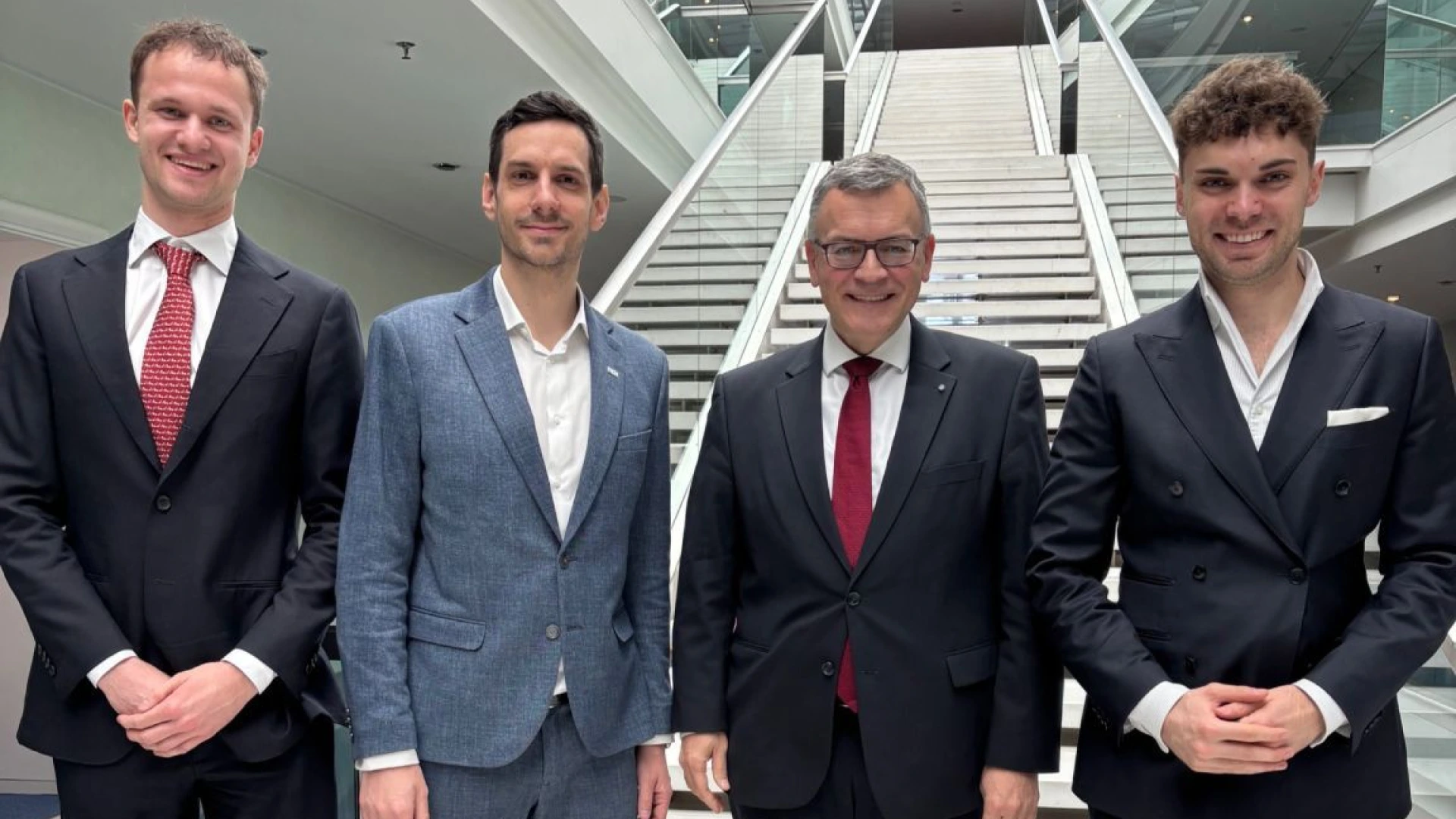
ERC leadership met State Minister Florian Herrmann at the Bavarian State Chancellery. The conversation: why milestone-based public funding is the mechanism that consistently turns aerospace prototypes into industrial capability.
Milestone-Based Funding is a Key Enabler for Breakthrough Aerospace Innovation in Germany
Yesterday, our colleagues David Loebl, Maximilian Oligschläger and Benedikt Albertsen had the honor of meeting State Minister Florian Herrmann at the Bavarian State Chancellery to discuss the future of electric aviation in Germany and Bavaria.
Thank you for the open and forward-looking exchange, Dr. Hermann.
Electrified aviation is more than just another means of transportation. It is a strategic capability that strengthens European resilience and reinforces our technological sovereignty.
To scale deep-tech aerospace, milestone-based funding is essential. Public funding tied to verified technological progress reduces government risk, increases accountability and unlocks private capital for strategically important technologies.
Bavaria has the ecosystem to lead. With the right milestone-based public funding program in place, it can shape Europe’s aerospace future.
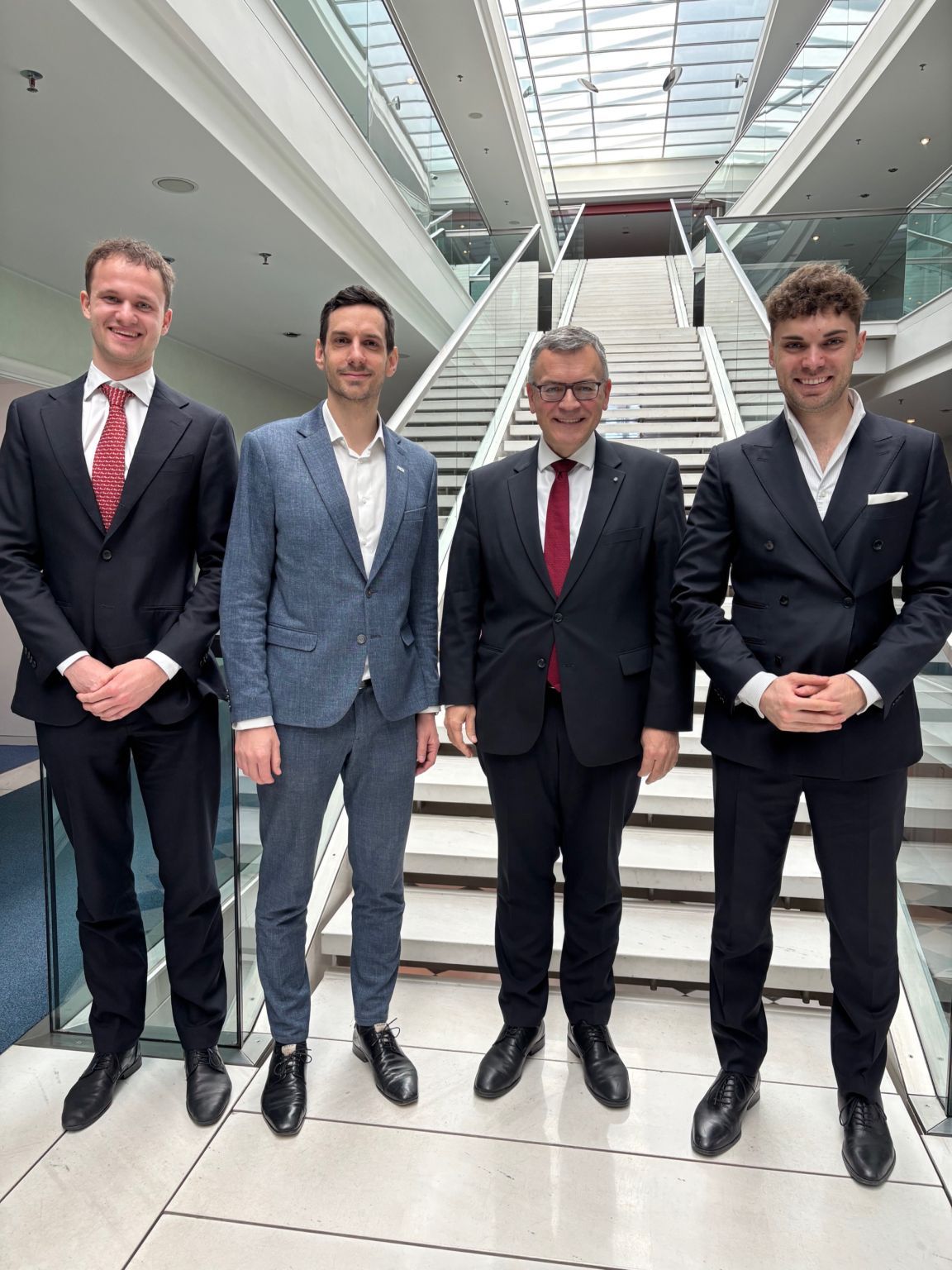
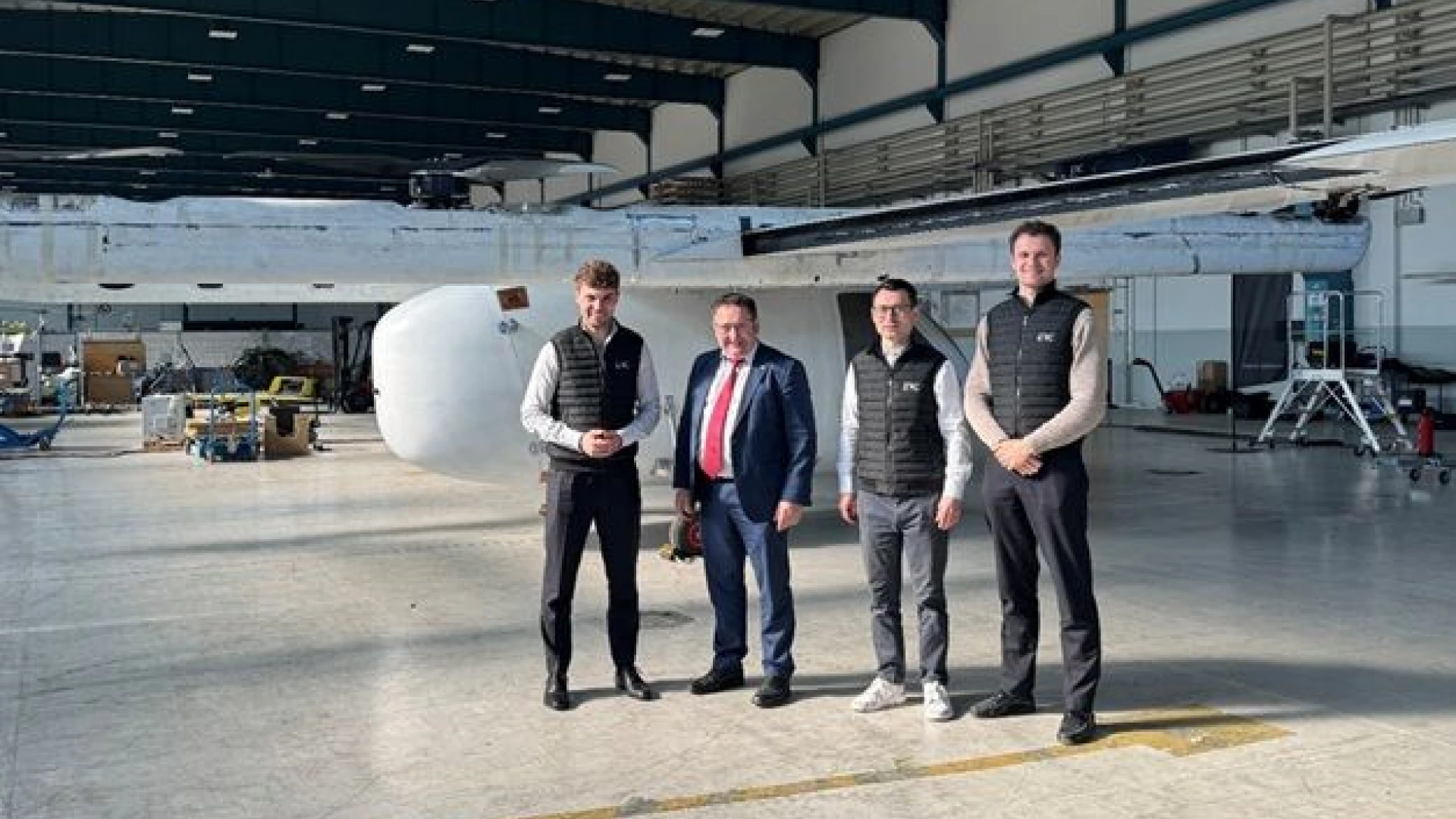
Tobias Gotthardt, Vice Minister in the Bavarian Ministry of Economic Affairs, visited ERC's flight test facilities in Erding. The conversation moved past the prototype to the harder question: how electrified aviation gets industrialized in Europe.
From flying hardware to a fielded capability
This week, our colleagues Maximilian Oligschläger, Andreas Thellmann, and Benedikt Albertsen had the honor of hosting Tobias Gotthardt, Vice Minister in the Bavarian Ministry of Economic Affairs, at our flight test facilities in Erding.
We presented our full-scale & full-mass prototype, which has been flight testing since November. Now it is time to build the ecosystem around the vehicle together with partners and suppliers and to take steps towards industrialization.
We share the view that electrified aviation can be the key enabler of numerous critical missions: Real use cases such as air medical services, defense, firefighting, or special logistics.
To strengthen European resilience and technological sovereignty, we need more competitive funding support in Europe, as well as strong political commitment to support early-stage ventures on their journey towards market entry.
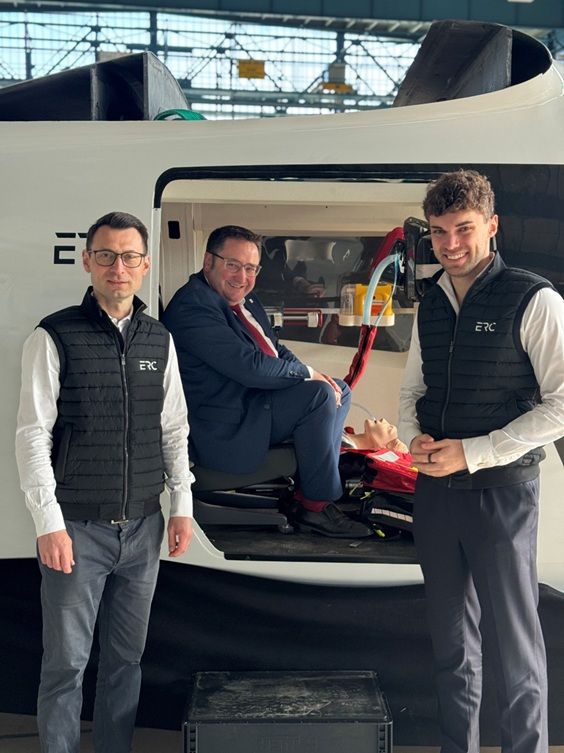
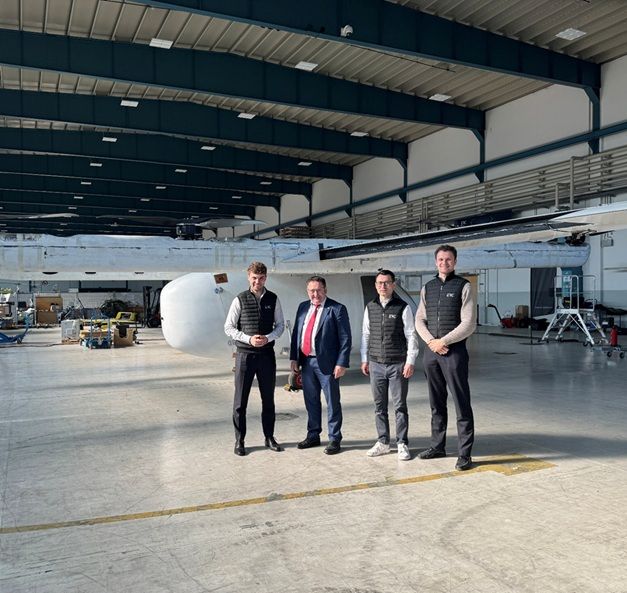
4 people in formal clothing standing side by side in front of the ERC Charlie C700 aircraft in a hangar.
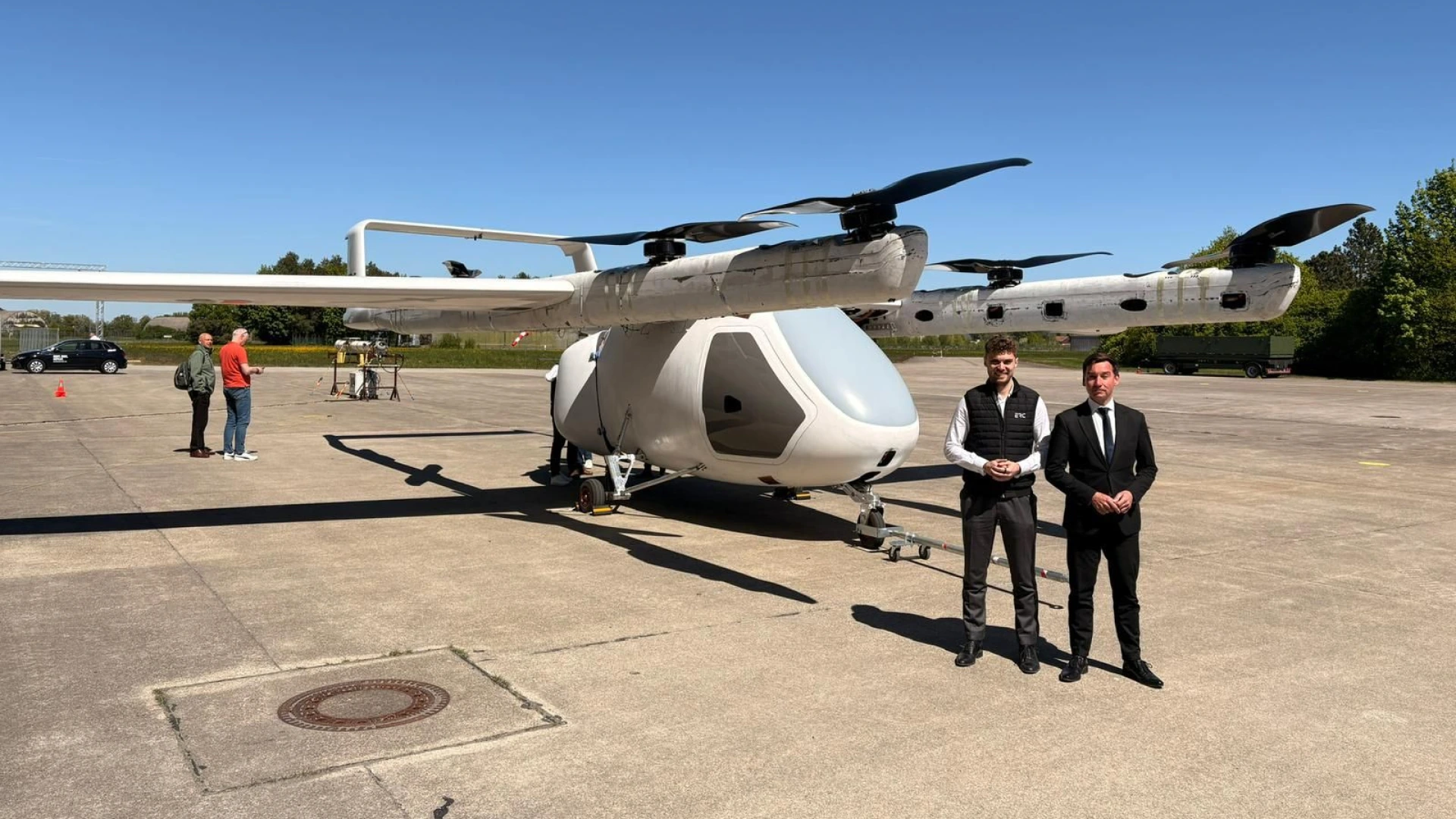
Staatssekretär Sebastian Hartmann visited ERC's Erding flight test facilities. The conversation: a specific operational gap that unmanned VTOL aircraft can close, and the German innovation ecosystem needed to deliver on it.
Unmanned VTOL Aircraft Can Close Critical Gaps in Military Logistics
Last week, we had the pleasure of welcoming Staatssekretär Sebastian Hartmann to our flight test facilities in Erding.
During the visit, we shared a first sneak peek of our upcoming unmanned product and discussed a clear capability gap in military logistics: delivering payloads <500 kg over significant range, autonomously, at high speed, and with vertical take-off and landing capability (see also study by European Defence Agency for Unmanned Aerial Logistics for this).
This is exactly where unmanned VTOL aircraft can create real operational value.
We also discussed the importance of strengthening Germany’s innovation ecosystem for dual-use and defense-relevant aerospace technologies.
Initiatives such as Bayern Innovativ GmbH and the "Innovationszentrum der Bundeswehr" play an important role in creating access, visibility, and opportunities for startups developing strategically relevant capabilities.
A big thank you to Sven L. Rochier, Patrick Albrecht, Christoph Heinen & Co for organizing yet another great dialogue and for continuously building bridges between startups, industry, and public stakeholders.
Press information
and assets.
Press materials, imagery, and brand assets for journalists, broadcasters, and media professionals.
All content is cleared for use under ERC's media guidelines.