About the role
We are looking for an experienced Masses, Loads and Vibration Engineer to join our young and growing flight physics team. In this role, you will act as the interface between the flight physics and structure teams: you will provide the mass estimations, derive the critical load cases from all relevant flight conditions, and quantify and mitigate vibrations for an unmanned, hybrid-electric VTOL transition aircraft. You will be responsible for the mass model, the design load envelopes and the vibration environment from early design through test verification, and your results directly shape structural sizing, performance predictions and the certification evidence of our aircraft. Working close to the hardware is part of the job - ground vibration tests, load testing and flight test verification rely on your hands-on involvement from planning through evaluation.
What you will do
- Develop and maintain a mass model for all aircraft parts and equipment, including derivation of the weight & balance envelope.
- Define, verify and document design load envelopes (flight, ground, gust, maneuvers, landing and payload), traceable to certification bases.
- Release critical load cases to a configuration-controlled database that serves as input to the structure team.
- Quantify vibration sources and their propagation through structural parts, and design and test mitigation means.
- Analyze and demonstrate aeroelastic stability (flutter, whirl flutter, divergence) across the envelope.
- Maintain structural elastic models (stiffness and modal representations) and provide them to simulation and control design.
- Plan, conduct and evaluate verification campaigns: interface load testing, ground vibration tests and flight test points.
what you bring
- You hold an academic degree in Aerospace or Mechanical Engineering or a comparable technical course of study.
- Five or more years of professional experience in loads analysis, structural dynamics or mass properties in aerospace round out your background.
- Working with loads and dynamics toolchains, preferably Python, is something you're comfortable with.
- A sound understanding of loads and vibration requirements in a certification context is part of your expertise.
- Target-oriented self-management comes naturally to you, along with the ability to work both within a team and autonomously.
- Strong problem-solving, communication, and technical writing skills complete your profile.
- Fluent English rounds out your qualifications.
The following would further strengthen your application:
- Rotorcraft or eVTOL experience, particularly with rotor-induced vibration, is a plus.
- Hands-on involvement in ground vibration testing or flight test campaigns adds to your profile.
- Experience with aeroelastic stability analysis, such as flutter or whirl flutter, is a valuable asset.
- Familiarity with FE-based structural dynamics tools, such as Nastran, strengthens your application.
- Mass properties management according to industry practice is an area you bring experience in.
What we offer
- Full-scale aerospace engineering — not concept slides.
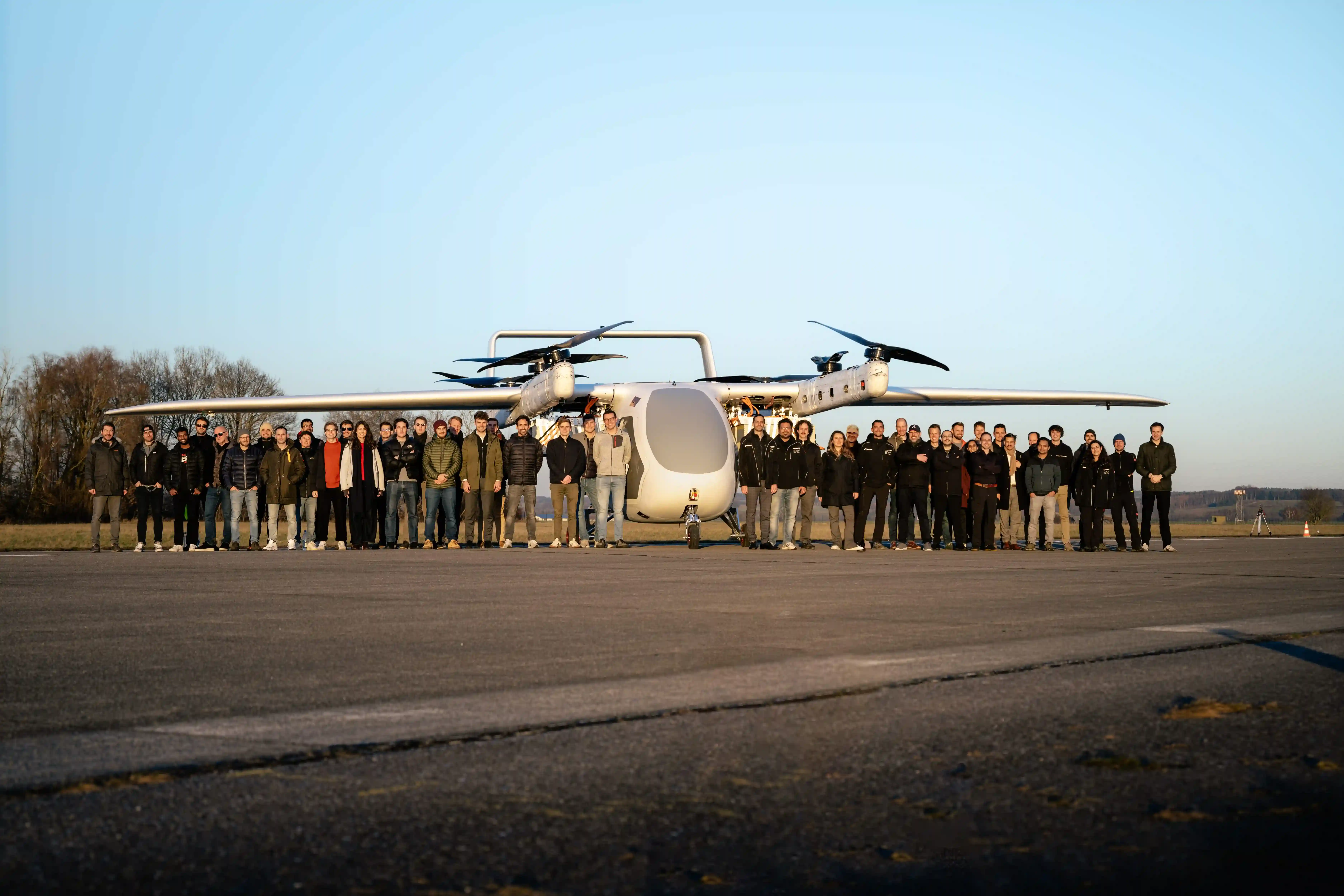
- A 60+ engineer team at Ottobrunn, backed by IABG and developed alongside TUM and DRF Luftrettung.
- Competitive compensation.
Your team
The HIRING process
- Introductory Chat
- Technical or Functional Deep-Dives
- On-site Interview and Get-to-Know
- Decision